The 3 Parenting Patterns That Quietly Weaken Drive
Most parents who reach out to me aren’t struggling with obvious parenting problems.
Their kids aren’t failing. Their households aren’t chaotic. By most measures, things are working.
But something feels off. The child doesn’t push themselves. Nothing gets started without prompting. Everything runs smoothly…until you step back. Then it doesn’t run at all.
What these parents have in common isn’t a parenting failure. It’s a set of patterns that made complete sense when their child was younger — and quietly started working against drive as the child grew.
Here are the three I see most often.
Pattern 1: The Reminder System
You remind your child about the homework. The practice. The chore they already know is theirs.
You do this because it works. Because without it, things fall through the cracks. Because the alternative — watching something fail — feels like neglect when you could have just said something.
But here’s what the reminder system actually does over time: it transfers ownership of the deadline from the child to you. Your child stops holding the task in their own head because they don’t have to. You’re holding it for them.
One parent I worked with realized her 13-year-old had never once started homework without a prompt. Not because he couldn’t — but because the system never required him to. He was waiting, every day, for the signal that it was time. And every day, it came.
“The moment you remind, it’s yours again.”
The pattern shows up like this: Your child knows what they’re supposed to do. They’re just waiting for you to confirm it’s time.
Pattern 2: Pre-Solving Problems
Your child mentions a challenge — a hard assignment, a conflict with a friend, a task that isn’t going well. And before the discomfort has a chance to sit, you move toward the solution.
This comes from a genuinely good place. You can see the solution. Watching your child struggle when you could help feels like withholding.
But problem-solving is a muscle — and a muscle only develops under load.
When a child grows up in a home where challenges get pre-solved, they learn to bring you problems rather than sit with them long enough to generate their own answers. The result is a child who is competent inside support and uncertain outside it.
The pattern shows up like this: Your child brings you problems they could work through on their own — and waits for your direction before they try.
Pattern 3: Over-Structuring the Environment
This one is the hardest to see, because it looks like excellent parenting.
The schedule is organized. The systems are in place. Every task has been broken down, every routine has been thought through, every transition has been planned.
What a well-structured environment doesn’t provide is voluntary friction — the productive discomfort of figuring something out without a blueprint, managing a gap that no one filled, taking responsibility for an outcome that was genuinely uncertain.
Drive doesn’t develop in frictionless environments. It develops when a child encounters a real problem that is theirs to solve — and has to decide what to do next without being told.
The pattern shows up like this: Your child does well when the path is clear and stalls when it isn’t. Ambiguity isn’t something they were ever asked to sit with.
What These Three Have in Common
None of them are bad parenting. In fact, they tend to show up most in homes where parents are the most thoughtful, most involved, most committed to doing things well.
The patterns aren’t the problem. The problem is that they were built for a younger child and didn’t evolve. What protected a seven-year-old starts to limit a twelve-year-old. What scaffolded a ten-year-old starts to carry a fifteen-year-old.
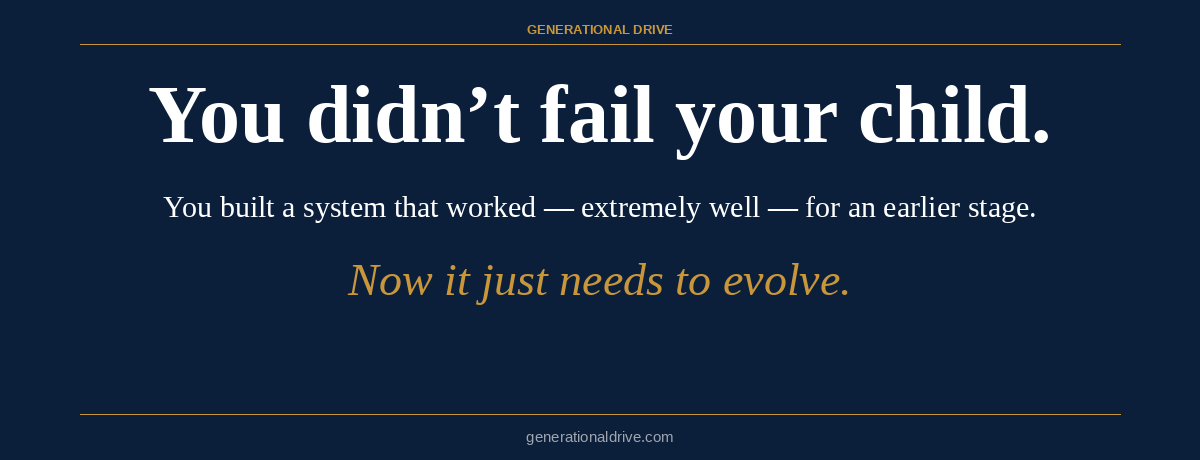
You didn't fail your child. You built a system that worked beautifully for one stage — and now it needs to evolve.
Does Any of This Sound Familiar?
Most parents who read this recognize one or two of these patterns immediately. What the Diagnostic shows you is which one is actually running the system — and where to start shifting it.